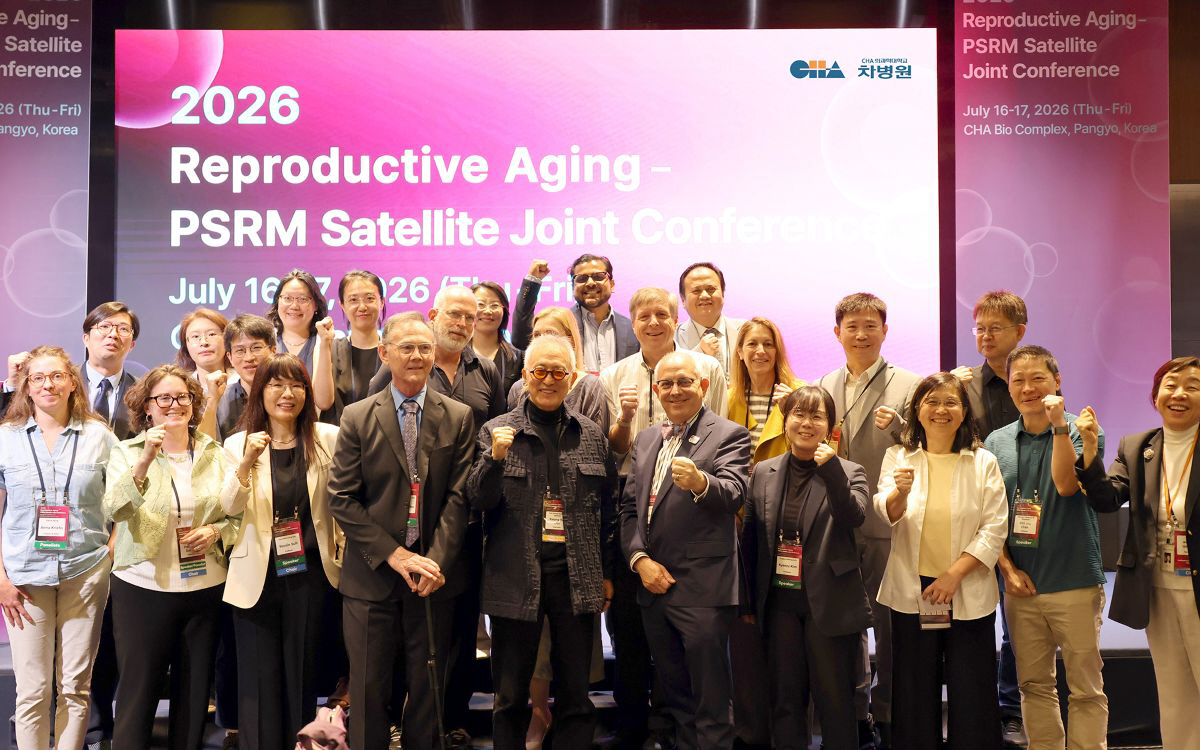
[Sportschosun Reporter Jang Jong-ho] CHA Medical Center announced that it held the world’s first international conference combining reproductive medicine and longevity at the CHA Bio Complex in Pangyo from the 16th to the 17th.
The event went beyond infertility and pregnancy treatment to raise a new medical question: how to improve women’s lifelong health and extend healthy lifespan. More than 700 experts from Korea and abroad in reproductive medicine and aging attended.
Until now, reproductive medicine and aging research have been treated as separate fields. At this conference, CHA Medical Center brought together leading global scholars from both areas to discuss whether slowing reproductive aging could also delay systemic aging and the onset of disease. Participants agreed that the ovaries should be viewed not simply as reproductive organs, but as key organs that influence women’s overall aging and healthy lifespan.
The conference featured keynote speeches and a range of presentations on research linking reproductive aging and longevity. In his keynote address, Professor Uri Alon of the Weizmann Institute of Science in Israel introduced the epidemiology of menopause based on analysis of 300 million laboratory data points. He stressed that future medicine should move beyond treating individual diseases and toward slowing down aging itself. Professor Rogerio Lobo of Columbia University in the United States also drew strong interest with a presentation on the effects of hormone therapy after menopause and its impact on women’s health.
Other presentations included Professor Seo Yoo-shin of Columbia University on telomere genetics-based research into ovarian aging; Professor Guanghui Liu of the Chinese Academy of Sciences (CAS) on aging reprogramming beyond ovarian aging; Professor Hwang Jong-wei of the National University of Singapore (NUS) Yong Loo Lin School of Medicine on how inflammatory aging of the ovaries affects reproductive and healthy lifespan; ASRM CEO Jared Robbins on expanding fertility treatment and its links to innovation, equity and global demand; Professor Paula Amato of Oregon Health & Science University on the role of mitochondrial dysfunction in ovarian aging and potential therapeutic targets; and Professor Brian Kennedy of NUS on anti-aging therapeutics and the future of interventions for reproductive aging.
After the lectures, attendees continued practical discussions through a Q&A session on the next challenges for longevity research and future directions. A panel discussion titled "Maintaining Momentum in Women’s Health Research and Securing Funding and Visibility" focused on the continued development of women’s health research and ways to strengthen international cooperation.
ASRM CEO Jared Robbins said, "I am glad that this conference was held at a time when more support is needed to activate research that views reproductive medicine from the perspective of aging," adding, "I would like to thank Chairman Cha Kwang-yul, who has always worked hard for the future and advancement of reproductive medicine."
Professor Seo Yoo-shin of Columbia University said, "This conference expanded the perspective beyond reproductive health to women’s health and longevity research," and added, "I hope CHA Medical Center will take the lead in shaping a new paradigm for women’s health research in the fields of longevity and reproductive aging."
Professor Rogerio Lobo, a Columbia University professor and former president of ASRM, stated, "We have continued research exchanges with CHA Medical Center, but visiting through this conference made it even more meaningful," and added, "I hope international exchanges for the advancement of reproductive aging and longevity research will continue actively in the future."
Cha Kwang-yul, head of the Global Research Institute at CHA Medical Center and CHA Bio Group, said, "It is meaningful to discuss the future of a new field of medicine that combines reproductive medicine and longevity with world-class scholars," and emphasized, "By mobilizing CHA Medical Center’s world-class expertise in infertility and reproductive medicine, as well as its K-Cell research capabilities, we will lead convergent research that goes beyond overcoming infertility to slowing systemic aging and extending healthy lifespan."
Reporter Jang Jong-ho, bellho@sportschosun.com
This article has been translated by GripLabs Mingo AI.