

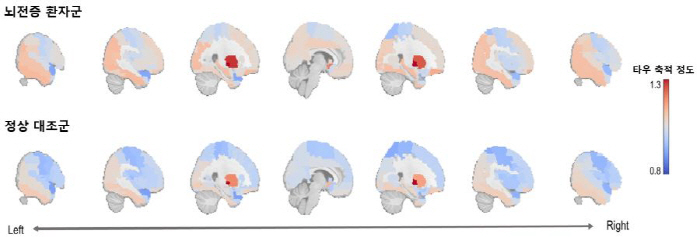
[Sportschosun Jang Jong-ho] A research team at Seoul National University Hospital has found that epilepsy patients with no diagnosis of Dementia or subjective memory decline showed significantly higher PET signals related to tau, a protein central to Dementia research, than healthy controls. The finding is significant because it demonstrates in vivo that epilepsy itself may be accompanied by neurodegeneration-related changes even when no outward Dementia symptoms are present. The study was published online in the international journal Brain.
Tau normally helps support the cell skeleton inside brain cells, but when it clumps abnormally, it forms neurofibrillary tangles that destroy neurons and is considered a major cause of neurodegenerative diseases such as Alzheimer's disease (AD). Epilepsy and Dementia have long been viewed as separate conditions, but recent animal studies and analyses of patient brain tissue have begun to suggest that epilepsy may promote tau accumulation. However, it has not been fully established whether tau actually builds up in epilepsy patients without Dementia, or how it relates to clinical symptoms.
To investigate this, a research team led by Professors Lee Sang-geon and Joo Geon of the Department of Neurology and Professor Choi Hong-yoon of the Department of Nuclear Medicine at Seoul National University Hospital, along with Clinical Associate Professor Hong Sang-bin of the Department of Clinical Genomic Medicine and Professor Shin Yong-won of the Department of Critical Care Medicine, conducted tau PET, amyloid PET, and blood proteome analysis in 75 epilepsy patients without a diagnosis of Dementia or memory impairment and 47 healthy controls.
The analysis showed that epilepsy patients had significantly higher tau PET signals across the cerebral cortex than the control group. Blood tests also found that the proportion of phosphorylated tau levels, a marker linked to tau pathology, exceeding the reference range reached 24%, about five times higher than the 5% seen in controls. By contrast, amyloid protein, another cause of early Alzheimer's disease, showed no significant difference between the two groups. The distribution pattern of tau PET signals also differed from that seen in Alzheimer's disease, confirming that the phenomenon is an independent pathological process associated with epilepsy itself rather than with Alzheimer's disease.
This tau accumulation was more pronounced as epilepsy became more severe and widespread. Patients with multifocal epileptiform discharges, in which abnormal electrical signals appear in multiple areas of the brain, showed the highest tau signals, and the association remained even after strict statistical adjustment. Higher tau levels were also observed in patients whose EEG activity had slowed or whose seizures had continued since adolescence. In patients whose seizures began in only one hemisphere, tau was more concentrated in that side of the brain. Patients who developed epilepsy after encephalitis showed the highest tau signals, suggesting that inflammation may be a factor that promotes tau accumulation.
The study also found that epilepsy is not limited to the brain but is linked to accelerated systemic aging. When biological age was estimated using blood proteome testing, epilepsy patients showed accelerated aging across the brain, kidneys, muscles, pancreas, and other organs, and this pattern was associated with brain tau signals. In particular, patients with stronger tau signals had higher levels of proteins related to mitochondrial function and oxidative stress. Meanwhile, microglia-related proteins involved in clearing damaged substances in the brain and proteins involved in immune cell recruitment showed an opposite relationship with tau signals. This suggests that tau-related changes in epilepsy patients may be tied not only to energy metabolism and oxidative stress, but also to changes in the brain's immune and clearance systems.
The research team said the findings open a new way to assess the disease burden of epilepsy using tau PET or blood biomarkers, and also provide a basis for extending anti-tau treatment strategies originally aimed at Alzheimer's disease to epilepsy treatment in the future. However, they added that the results do not mean epilepsy is the same as Alzheimer's disease, and that large-scale, multicenter, long-term follow-up studies are needed to clarify the causal relationship.
Professor Lee Sang-geon of the Department of Neurology said, "It was striking that tau-related PET signals were more distinct than expected in epilepsy patients without Dementia symptoms." He added, "It will be important to see whether tau PET can be used in the future as a tool to assess Dementia risk and neurodegenerative changes in epilepsy patients."
Professor Joo Geon of the Department of Neurology said, "It is highly meaningful that we were able to confirm, through actual brain imaging and blood analysis from patients, that epilepsy is linked not only to seizure disorders but also to changes in brain proteins and even systemic aging."
Jang Jong-ho bellho@sportschosun.com