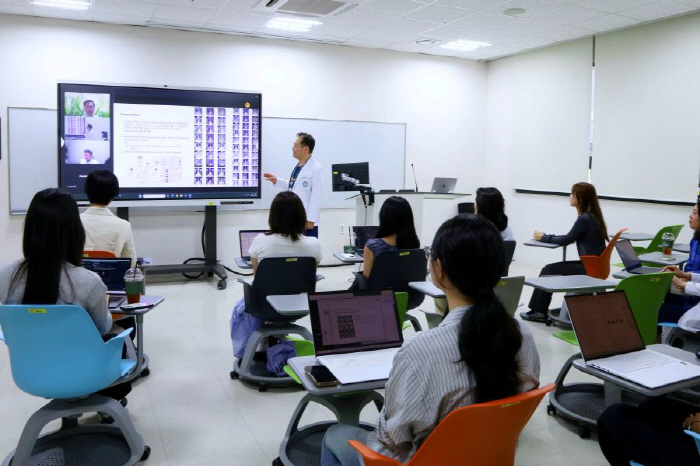


[Sportschosun Jang Jong-ho] A research team led by Professor Kim Kwan-chang of the Department of Thoracic and Cardiovascular Surgery, Professor Kang Seo-young of the Department of Nuclear Medicine at Ewha Womans University Seoul Hospital, and Professor Ahn So-hyun of the Ewha Womans University Medical Science Research Institute is leading related research by successively presenting two studies that combine artificial intelligence (AI) with chest imaging to the international academic community.
The first study was a clinical trial that evaluated diagnostic accuracy by applying an AI-based osteoporosis screening system to portable chest X-ray images. It has been accepted for publication in the Journal of Thoracic Disease, an international SCI(E)-listed journal in the field of respiratory and thoracic medicine. The study was led by Kim Ji-hyun, a thoracic and cardiovascular surgery resident, as first author, with Professor Kim Kwan-chang as corresponding author.
Dual-energy X-ray absorptiometry, or DXA, the standard test for diagnosing osteoporosis, requires expensive equipment and specialized personnel, making it less accessible at primary care clinics and in medically underserved areas such as rural communities. As a result, many older adults miss the chance for proper diagnosis and treatment. Focusing on this diagnostic gap, the team examined the clinical potential of an opportunistic screening strategy that analyzes portable chest X-ray images already taken for tuberculosis mobile screening with AI, without any additional imaging or radiation exposure.
The study involved 52 residents aged 60 and older who participated in a community mobile screening program run by the Ulsan-Gyeongnam Branch of the Korean National Tuberculosis Association. When the portable X-ray images were analyzed with commercial AI software and compared with DXA results, the AI model accurately screened for osteoporosis with an area under the curve, or AUC, of 0.86 and a sensitivity of 90%. The findings showed that the model delivered meaningful performance even on images from mobile screening sites, not just from fixed hospital equipment.
The team explained, "This study shows the possibility of screening for osteoporosis with a single chest X-ray taken for tuberculosis screening, and it could serve as a useful reference for expanding access to on-site screening at public health centers and welfare facilities that do not have bone density equipment. We will continue follow-up research so that, after further validation, it can lead to early detection and fracture prevention."
The second study, an AI technology that automatically detects disease lesions in chest X-ray images, was selected for MICCAI 2026, the world's most prestigious international conference in medical image computing. Now in its 29th year, MICCAI is a highly competitive forum where leading scholars, engineers, and clinicians from around the world gather.
This study proposed a weakly supervised learning method that can identify chest disease lesions and estimate their locations using only image-level labels, without precise lesion coordinates. In particular, it incorporates the way doctors actually read images by tracing lesions along anatomical structures such as the heart and lungs, allowing the model to pinpoint even small and subtle lesions with precision. It is being recognized as an innovative approach that could ease the practical constraints of building large-scale training datasets with manually marked lesion locations.
The study was led by Kim Jeong-in, a student in the integrated master's and doctoral program at the College of Artificial Intelligence, as first author, with Professor Noh Jun-hyeok of the College of Artificial Intelligence and Professor Kim Kwan-chang serving as corresponding authors. The project was completed as a converged study through close collaboration between engineering and clinical medicine.
These achievements reflect the results of Ewha Womans University’s proactive efforts to build education and research infrastructure that integrates medicine and engineering. At present, students enrolled in the graduate Interdisciplinary Program in Computational Medicine and the undergraduate Interdisciplinary Major in Computational Medicine are participating in the Ewha Medical Center AI Research Team, actively carrying out practice-oriented converged research.
Ewha Womans University launched the graduate Interdisciplinary Program in Computational Medicine in 2019 and established the undergraduate Interdisciplinary Major in Computational Medicine in 2021, taking the lead in two-way education that bridges engineering and medical science. Through this program, which seeks new treatments by analyzing clinical data, many premedical students have gone on to double major in computer engineering and grow into future-oriented interdisciplinary talent.
Meanwhile, MICCAI 2026 will be held in Strasbourg, France, from Sept. 27 to Oct. 1 under the theme "From Algorithms to Clinical Translation." The research team plans to attend the conference, present its findings in person, and exchange ideas with international researchers.
The team said, "These two studies are an attempt to maximize the practical value of the most common and accessible chest X-ray exam by combining it with AI technology. We will continue to pursue converged research that begins with the problems faced in clinical settings."
Jang Jong-ho, bellho@sportschosun.com