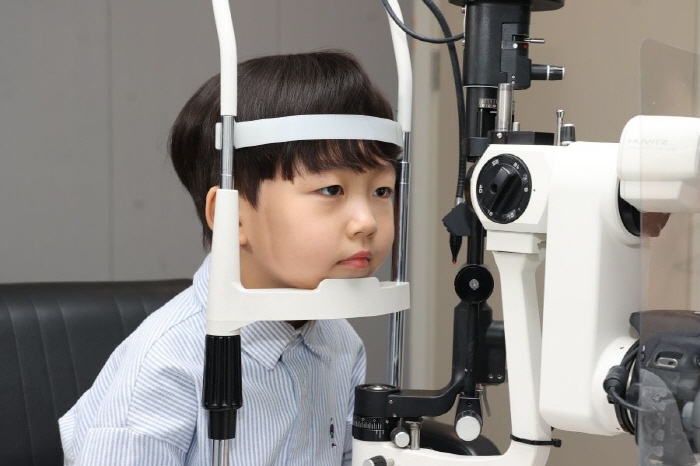
As summer vacation gets underway, many people are choosing to undergo vision correction surgery.
When people think of vision correction, they often focus only on myopia. But the hidden key that determines the quality of vision after surgery is astigmatism.
Unlike myopia, which shifts the focal point forward or backward, astigmatism occurs when the cornea is distorted like a rugby ball, preventing light from converging at a single point and causing it to scatter in all directions. Because astigmatism is strongly influenced by genetics, it is a major cause of overlapping letters and chronic eye strain.
Astigmatism is especially difficult to correct because it has its own direction, or axis. If that axis is not aligned precisely, a patient may be able to read the numbers on a vision chart after surgery, but the sharpness of vision will still be blurred.
In fact, even a three-degree misalignment in the astigmatism axis can reduce the corrective effect by about 10%. For patients with severe astigmatism, then, the key factor in surgical outcomes is how precisely the axis is aligned.
One reason astigmatism correction has long been especially difficult is the time gap between examination and surgery.
Vision tests are performed while sitting, but surgery is done while lying down. As the body position changes, the eyeball rotates slightly, creating a refractive shift. In other words, there can be an error between the astigmatism axis measured while sitting and the actual axis when lying down. In conventional surgery, medical staff had to calculate and predict these subtle changes themselves and reflect them in the procedure, making the surgeon's experience absolutely essential.
The recently popular SMILE Pro (VisuMax 800) has addressed these technical limits with an advanced system. Its ocular alignment function precisely detects the subtle rotation of the eyeball that occurs when a patient lies down and adjusts the laser delivery position in real time. Combined with a feature that automatically detects the visual axis and accurately centers it, the system has dramatically improved the precision of astigmatism correction.
However advanced the latest equipment may be, the depth of the result still depends on the skill of the medical team. True technical capability is proven through the synergy between the precision of the device and the accumulated data of the surgeons. Our clinic has extensive know-how in corneal transplantation, one of the most difficult eye surgeries and a procedure in which astigmatism control is essential. The vast nomogram data accumulated through that experience is a unique asset that complements the device's automation features and minimizes errors in astigmatism correction.
That synergy becomes even greater when combined with a 1 mm micro-incision technique that preserves the cornea's natural strength. By minimizing corneal damage during surgery, it also helps block the possibility of surgically induced astigmatism from the outset.
Successful astigmatism correction is not just about reducing glare. The goal is to make the edges of objects appear as sharply defined as if they had been cut with a knife. When SMILE Pro, a proven state-of-the-art device, meets the technical expertise built through experience in complex corneal surgery, the world finally becomes brighter in the most precise and safest way. If you have long been stressed by severe astigmatism, this summer may be the right time to redraw the map of your eyes at a place where both technology and experience have been proven.
Courtesy of Director Kim Boogi of Onnuri Smile Ophthalmic Clinic