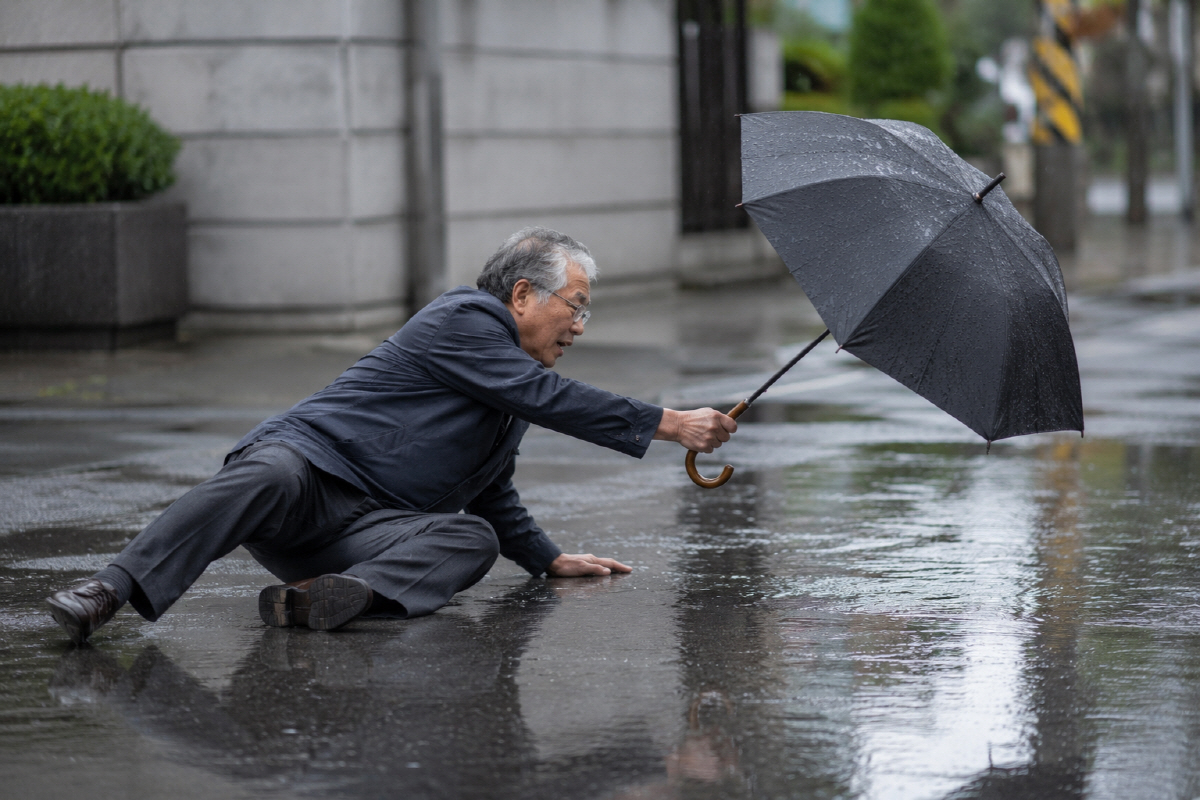
[Sportschosun Reporter Jang Jong-ho] The monsoon season is especially dangerous for older adults. Because seniors generally have poorer balance, flexibility, bone density and muscle strength, they are less able to respond to sudden falls. Heavy seasonal rain also reduces visibility, while umbrellas make it harder to keep steady footing. Wet sidewalks, crosswalks, sloped roads and humid indoor environments are among the main causes of fall accidents during the rainy season.
◇Slipping on wet roads leads to the highest number of spinal compression fracture patients in July for two straight years
When people slip on a rainy road, they usually fall backward and land on their hips. The impact from the ground is then transmitted through the pelvis to the spine. If the bones cannot withstand the force, a spinal compression fracture occurs, causing the vertebrae to collapse and flatten. According to statistics from the Health Insurance Review & Assessment Service (HIRA), 33,507 patients visited hospitals for lumbar fractures in July 2024, the highest monthly total that year. In July last year, the number reached 34,190, marking a second consecutive July peak. By comparison, January 2025, the winter season, recorded 30,437 patients, a difference of nearly 4,000. Fractures from falls are often associated with winter, but the highest number of lumbar fracture patients actually appears in midsummer, including the monsoon period.
The weaker the bones, the greater the risk of fracture even under the same impact. In particular, patients with osteoporosis and older adults are more vulnerable to spinal compression fractures. Of the 164,537 lumbar fracture patients last year, about 95 percent were aged 50 or older, meaning more than nine out of 10 were seniors.
Compression fractures are also difficult to detect early, despite the name. Because the pain often eases when a person lies still, it is easy to mistake it for simple muscle pain. If treatment is delayed, the condition can lead to spinal deformity or chronic pain. If back pain continues for several days after a fall, professional treatment is recommended.
When a spinal compression fracture causes severe pain or instability, cement procedures such as percutaneous vertebroplasty or kyphoplasty may be considered. However, surgical treatment carries risks such as cement leakage, soft tissue damage, nerve root compression and adjacent vertebral fractures, so it must be approached with caution. In many cases, conservative treatment such as bed rest, a lumbar brace and physical therapy is recommended. Still, prolonged bed rest can weaken the muscles and ligaments around the lower back, so early movement is encouraged whenever possible. For that reason, some patients choose integrated Korean medicine treatment to shorten bed rest and help them return to daily life sooner.
The effectiveness of integrated Korean medicine treatment for spinal compression fractures has also been demonstrated in various studies. In one study published in the SCI(E)-indexed international journal Medicine by the Jaseng Hospital of Korean Medicine Spine and Joint Research Institute, the Numeric Rating Scale (NRS; 0-10) for pain in patients diagnosed with spinal compression fractures fell from 5.75 at admission to 3.90 after treatment, a decrease of 1.85 points. The Oswestry Disability Index (ODI; 0-100) also improved by 21.25 points, from 48.92 to 27.67. Lower NRS and ODI scores indicate less back pain and better function.
◇"I put my hand down first when I fell" Wrist sprains also peak in July... Take shorter steps and walk slowly
The lower back is not the only vulnerable area when a person falls. Once balance is lost, people instinctively reach out and brace themselves with their hands, which can place a heavy impact on the wrists. In particular, the body’s full weight and the force of the fall can concentrate on the wrists, causing sprains as ligaments stretch or tear.
As with lumbar fractures, wrist sprains also increase during the monsoon season. HIRA statistics show that wrist sprain patients reached 85,281 in July 2024, the highest monthly total that year. July last year also recorded the most cases, with 84,231 patients. By comparison, January 2025 had 63,371 patients and January 2024 had 70,483, meaning summer wrist sprain cases were more than 10,000 higher than winter cases.
Wrist sprains are also often dismissed because the pain tends to subside over time. But if the ligaments do not heal properly, chronic pain or repeated wrist instability can develop, making early treatment important. If the wrist swells or loses strength after a fall, it is best not to overexert it and to get an accurate diagnosis.
Kang In, head of the Spinal Compression Fracture Clinic at Ansan Jaseng Hospital of Korean Medicine, said, "During the monsoon season, the risk of falls rises because of wet roads, and the high humidity and low atmospheric pressure can worsen joint and muscle pain, causing musculoskeletal disorders to increase all at once." He added, "In particular, older adults with relatively lower bone density and muscle strength should not dismiss back or wrist pain after a fall as a temporary symptom. They need an accurate diagnosis." He also advised, "On rainy days, wear shoes with anti-slip features indoors and outdoors, and on wet stairs or sidewalks, take shorter steps and walk slowly. Preventing falls through daily habits is the most important thing."
Jang Jong-ho bellho@sportschosun.com