[Sportschosun reporter Jang Jong-ho] For adolescents, more physical activity appears to reduce loneliness and help ease excessive smartphone use.
The research team led by Professor Kim Jae-yup of the Department of Social Welfare at Yonsei University analyzed 1,000 middle and high school students nationwide. It found that physical activity helps offset the effects of emotional abuse on loneliness and smartphone overdependence among adolescents, according to a paper published in the Child and Adolescent Social Work Journal.
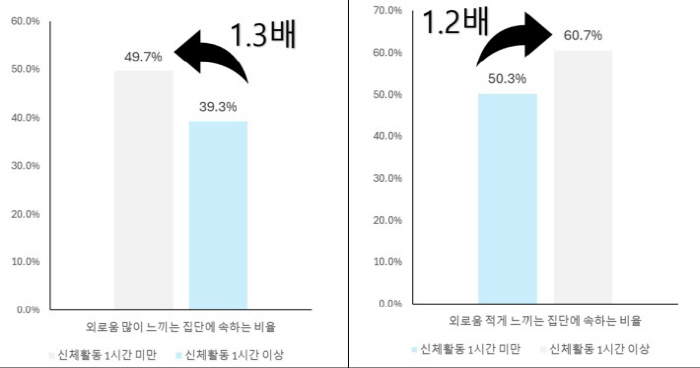
The World Health Organization (WHO) recommends that adolescents engage in at least one hour of physical activity per day on average to promote health and prevent disease. In fact, adolescents who exercised for less than one hour a day were 1.3 times more likely to fall into the group that felt more lonely than those who exercised for at least one hour. They were also 1.2 times more likely to belong to the group that felt less lonely. In addition, the more physical activity they did, the more it helped reduce the link between emotional abuse and loneliness.
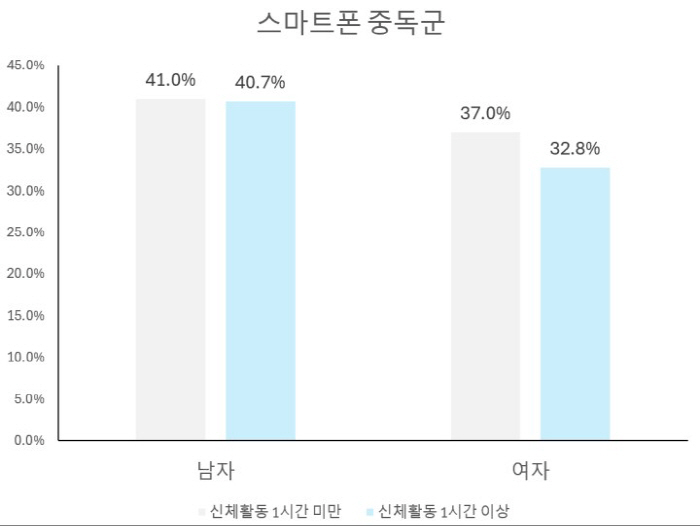
Physical activity was also found to ease smartphone addiction. Among boys, the smartphone addiction rate was 41.0% for adolescents who exercised less than one hour a day and 40.7% for those who exercised at least one hour, a marginal gap of 0.3 percentage points. Among girls, however, the rate was 37.0% for those who exercised less than one hour and 32.8% for those who exercised at least one hour, a gap of 4.2 percentage points. This suggests that physical activity can help reduce smartphone addiction, with a particularly strong effect among girls.
Kim Dong-hyun, who led the study, said, "Physical activity is often seen as less important than core subjects such as Korean, math and English, but it is an important factor that can help prevent loneliness and smartphone addiction among adolescents." He added, "To ensure that Korean teenagers get enough physical activity, the government, education offices and schools must work together and build a proper system." He continued, "These findings show that physical activity can protect adolescents' mental health in an education system that is heavily focused on college admissions." He also said, "For adolescents to live healthy and happy lives, not only society but also young people and their families must recognize the importance of physical activity."
Researcher Shin Na-eun said, "Emotional abuse has been relatively overlooked compared with physical abuse and neglect." She added, "Because emotional abuse affects adolescents' loneliness and smartphone addiction, it deserves close attention."
The study is expected to offer new direction for improving adolescent mental health and expanding physical activity.
Jang Jong-ho, bellho@sportschosun.com
This article has been translated by GripLabs Mingo AI.