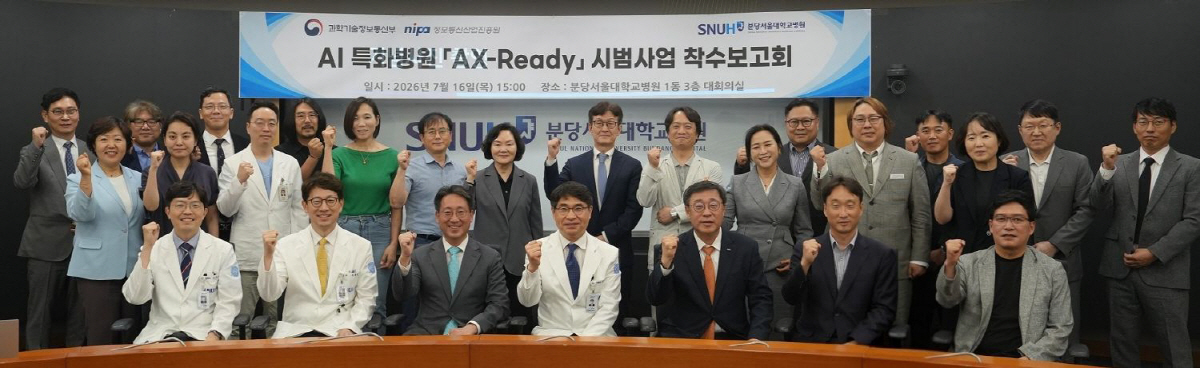
[Sportschosun Jang Jong-ho] Seoul National University Bundang Hospital is pushing ahead with a plan to build a 'full-stack medical AI integrated model' that connects the entire patient journey with artificial intelligence, from health management before a patient visits the hospital to treatment, consultations, and post-discharge prognosis management.
Through the AICON consortium, which includes 21 organizations, the hospital plans to demonstrate an integrated system linking treatment-support AI, a regional collaborative care platform, and hospital workflow automation solutions. It also aims to release the system as a standard asset and establish it as a model for nationwide expansion of AI-specialized hospitals.
Seoul National University Bundang Hospital and the Ministry of Science and ICT, together with the National IT Industry Promotion Agency (NIPA), held a launch briefing for the '2026 AX-Ready pilot project' at 3 p.m. on the 16th in the hospital's main conference room. They said the event marked the full-scale start of the 'Integrated Medical AI Operating Network Demonstration Project Based on the Full Patient Journey (AICON: AI Connected Care Operating Network).' The briefing was attended by Jeon Young-tae, president of Seoul National University Bundang Hospital; Lee Jin-su, director of the AI Policy Planning Bureau at the Ministry of Science and ICT; Park Yoon-kyu, president of NIPA; and about 40 representatives from organizations participating in the AICON consortium.
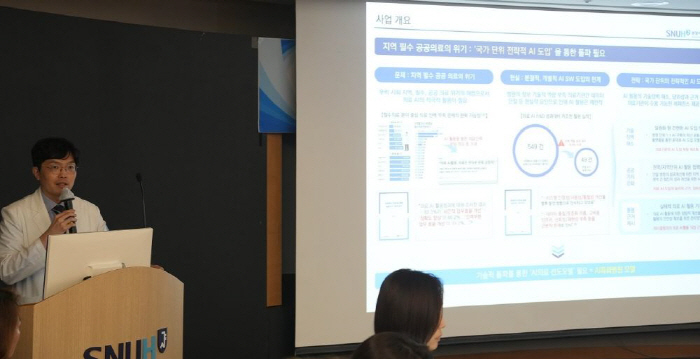
Medical AI in South Korea has grown rapidly, with cumulative approvals from the Ministry of Food and Drug Safety reaching 549 cases as of the first quarter of 2026. However, broad use in actual hospital settings remains limited. That is because hospitals differ in their information and technology capabilities, and introducing AI one by one creates heavy costs and a steep trial-and-error burden. The AX-Ready project is a national pilot initiative for a medical AI transformation designed to address these bottlenecks. Its goal is to create a strategic model for using medical AI to respond to regional and essential-care crises.
The consortium includes Seoul National University Bundang Hospital, Seoul National University Hospital, the National Medical Center, VHS Medical Center, Seongnam Medical Center, local hospitals and clinics, and other medical institutions representing every type of organization in Korea's healthcare system. It also brings together medical IT and AI companies such as EzCaretech, KakaoHealthcare, Bit Computer, Acryl, and Puzzle AI, along with academia including Seoul National University.
The demonstration will proceed in three packages. Package 1 is treatment-support AI, which links and uses 10 commercially available medical AI tools approved by the Ministry of Food and Drug Safety at different stages of care, including diagnosis, management, and prognosis prediction. Package 2 is a regional integrated AI collaboration platform that supports referrals and transfers between local medical institutions through patient-facing 'CareNavi,' clinician-facing 'CarePilot,' and an AI collaboration agent. Package 3 is hospital workflow automation and efficiency AI, which uses nine solutions to create a Smart Ward, including voice-based medical record automation, fall detection, and an emergency room AI agent.
In particular, the project adopts a 'many-to-many' model in which multiple hospitals introduce AI simultaneously on a common platform based on healthcare data standards (KR-Core FHIR) and AI integration standards (MCP). Unlike the conventional approach, in which each hospital builds its own separate system, the model significantly lowers adoption costs and technical barriers by allowing AI developed once to operate across multiple hospitals through standard specifications.
The six-step onboarding manual for medical AI adoption, the framework for diagnosing and evaluating an institution's AI utilization maturity, and the AI security and ethics governance system developed through the project will be released as 'standard assets' that any hospital can use. They are expected to serve as a leading model for the nationwide expansion of AI-specialized hospitals.
Jeon Young-tae, president of Seoul National University Bundang Hospital, said, "Until now, medical AI has been a 'point' technology that reads specific diseases. AX-Ready is about demonstrating a full-stack medical AI integrated model that connects the entire patient journey into one." He added, "Our goal is not technology for technology's sake, but AI that leads to patient safety and better treatment outcomes. We hope this demonstration will help establish the standard for medical AI in Korea."
Jung Se-young, head of the Information Systems Office and the project lead, said, "The bottleneck in using medical AI is not the technology itself, but the way it is introduced." He explained, "AICON creates a structure in which hospitals and AI meet on a standard-based common platform, which is the key to enabling not only large hospitals but also regional small and mid-sized hospitals and clinics to use the same level of AI."
He added, "When the project ends, it will leave behind a standard system that any hospital can follow, covering adoption procedures, maturity evaluation, and safety management." He said the team will objectively verify the impact by measuring participating medical institutions' AI utilization maturity before and after the project using the same criteria, and use the results as evidence for regional expansion.
Meanwhile, Seoul National University Bundang Hospital is the only institution in South Korea to have received four certifications for Level 7, the highest stage in the EMR maturity assessment (EMRAM) by HIMSS, a global healthcare IT evaluation body. In 2025, it also became the first in the Asia-Pacific region to obtain Level 7 in the latest revised version of the Data and AI Utilization Maturity Assessment (AMAM), earning international recognition for its ability to demonstrate medical AI.
Jang Jong-ho, bellho@sportschosun.com
This article has been translated by GripLabs Mingo AI.