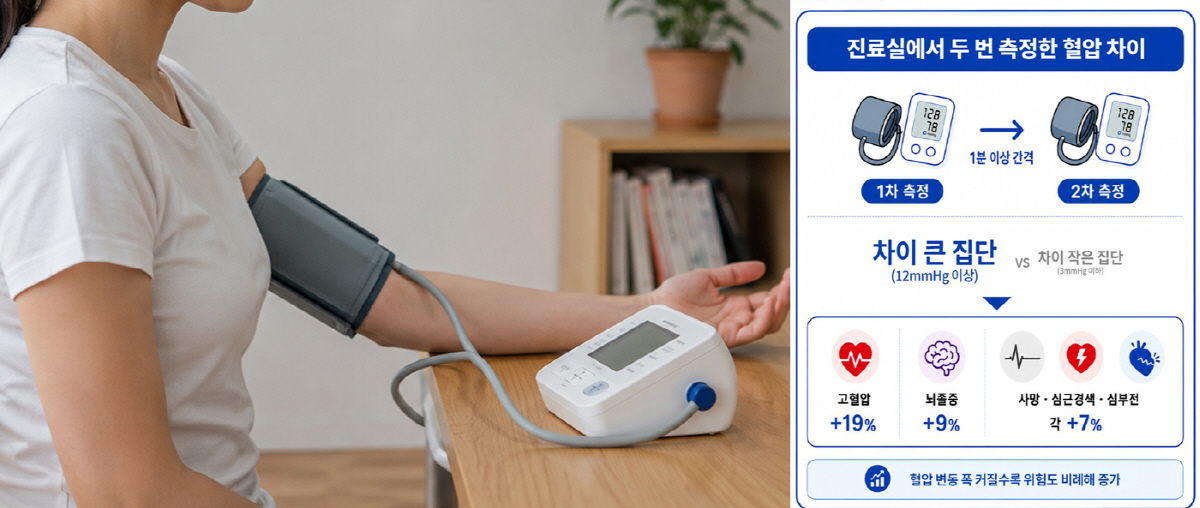
[Sportschosun, Jang Jong-ho] A study has found that even a slight difference between two blood pressure readings taken at short intervals in a clinic may be linked to the future risk of hypertension, heart disease, and stroke.
A research team led by Professor Bae Seong-a of the Department of Cardiology at Yonsei University Yongin Severance Hospital analyzed data from UK Biobank and followed 416,922 adults with no history of hypertension or cardiovascular disease for about 16 years. The team found that the larger the gap between the two blood pressure readings, the higher the risk of cardiovascular disease and death.
The study was conducted jointly by Professor Jin In-tae of the Department of Cardiology at Severance Hospital, Professor Heo Seok-jae of the Department of Biomedical Systems Informatics at Yonsei University College of Medicine, and Professor Bae Seong-a of Yongin Severance Hospital, who served as corresponding author.
In clinical practice, blood pressure is usually measured at least twice in succession. Until now, attention has focused mainly on the average of those readings, while the meaning of the difference between them has received relatively little notice.
Based on UK Biobank data in which blood pressure was measured twice at least one minute apart after five minutes of rest, the team classified systolic blood pressure differences into four groups: first quartile, 3 mmHg or less; second quartile, 4 to 6 mmHg; third quartile, 7 to 11 mmHg; and fourth quartile, 12 mmHg or more. It then compared death rates and the incidence of hypertension, myocardial infarction, stroke, and heart failure across the groups.
The most notable finding was that the greater the difference in blood pressure measured during a clinic visit, the higher the future risk of death and cardiovascular disease. Even after adjusting for factors that could affect the results, such as age, sex, smoking, body mass index, and baseline blood pressure, the group with the largest difference in blood pressure had about a 7% higher risk of death, myocardial infarction, and heart failure, and about a 9% higher risk of stroke, compared with the group with the smallest difference. The risk of newly diagnosed hypertension was about 19% higher.
Subgroup analysis also showed a relatively clear association with death and stroke risk among people under 65, and with death risk among smokers.
Notably, even among people whose blood pressure itself was not high, a large difference between clinic readings was associated with a higher risk of cardiovascular disease and death. This suggests that incorporating the difference between clinic blood pressure readings into cardiovascular risk assessment could help identify and manage high-risk patients early, even before they are diagnosed with hypertension.
Professors Jin In-tae and Heo Seok-jae, the co-first authors, said, "This study shows that not only the average blood pressure value, but also the difference within a single short clinic visit, can serve as an independent warning sign." They added, "The key finding is that simple information available immediately in the clinic, without any additional equipment or cost, is linked to health outcomes more than a decade later."
Professor Bae, the corresponding author, emphasized, "Even for people who do not meet the diagnostic threshold for hypertension, if the difference between clinic blood pressure readings is large, there is strong evidence that they should have their blood pressure checked more often and begin management earlier."
However, the research team noted that because this was an observational study, it is difficult to draw a causal conclusion. They also said further research is needed, as the study did not include blood pressure data measured outside the hospital, making it difficult to fully rule out the influence of temporary factors.
Meanwhile, the study was supported by the Ministry of Health and Welfare (MOHW) and the Korea Health Industry Development Institute's "Medical Technology Development Project Based on Virtual Patients and Virtual Hospitals" (principal investigator Park Jin-young). The findings were recently published in the Journal of the American Heart Association (JAHA), an international journal published by the American Heart Association (AHA).
Jang Jong-ho, bellho@sportschosun.com

This article has been translated by GripLabs Mingo AI.