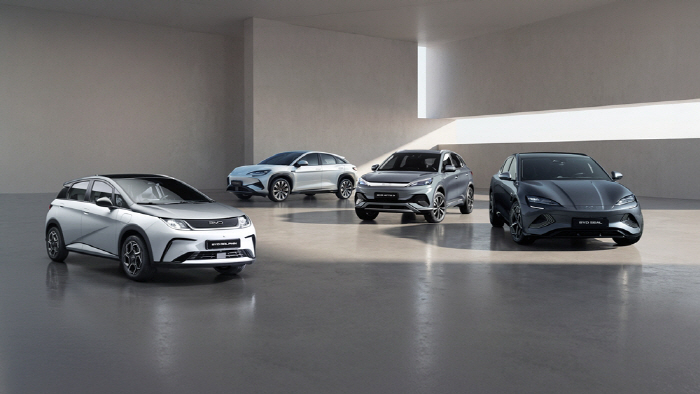
BYD Company Limited (BYD), the Chinese electric vehicle maker that sold 11,675 vehicles in South Korea in the first half of this year, posting a 807.9% increase from a year earlier, has run into a series of setbacks as the second half begins. The company was excluded from the government’s EV purchase subsidy program, and its first recall since entering the Korean market has added to the pressure. Industry observers say both price competitiveness and brand trust are now being tested at the same time.
According to the auto industry, BYD Korea was completely excluded from the government’s EV purchase subsidy program starting on the 1st. The company failed to meet the benchmark score of 60 points in the government’s first-ever evaluation for selecting EV supply project operators. The Ministry of Climate, Energy and Environment revamped the system this year to assess companies on technology development capabilities, contribution to the domestic supply chain, and after-sales service continuity. While 27 companies, including Hyundai Motor Company, Mercedes-Benz, and Tesla, passed, BYD was left out of the passenger vehicle category.
The government did not disclose detailed scores by company, but the industry believes BYD received relatively low marks in domestic supply chain contribution and after-sales service capability, the two categories with the heaviest weighting. The evaluation reflects overall service capacity, including repair staff and parts supply systems, rather than simply the number of service centers. BYD currently operates 20 service centers nationwide and plans to expand that number to 26 by the end of the year. However, only five of them can handle both collision repairs and general repairs. Industry sources say the still-developing domestic service network may have affected the assessment.
The subsidy exclusion also puts considerable pressure on BYD’s core pricing strategy. Until now, the company has sold models such as the BYD ATTO 3, BYD Seal, BYD Dolphin, and BYD Sealion 7 at lower prices than competing models, while further reducing the actual purchase burden by adding national and local government subsidies. In fact, the ATTO 3 received 1.26 million won in national subsidies, the Seal received 1.69 million won for the rear-wheel-drive model and 1.51 million won for the all-wheel-drive model, the Dolphin received 1.09 million won, and the Sealion 7 received 1.52 million won. As concerns grew that its price advantage could weaken, BYD launched a customer support program in July that provides company-funded support equal to the national subsidy amount. Under the program, BYD is covering 1.26 million won for the ATTO 3, 1.69 million won for the rear-wheel-drive Seal and 1.51 million won for the all-wheel-drive version, 1.09 million won for the Dolphin, and 1.52 million won for the Sealion 7.
The question is whether that support can last. While the government subsidy exclusion is unlikely to be resolved quickly, company-funded support requires a substantial budget from headquarters, making its long-term continuation uncertain. Some in the imported car industry say BYD’s price competitiveness could weaken if headquarters stops backing the program.
A BYD Korea official told Sportschosun, "Subsidy support requires a significant budget, so there are many internal factors to review and we need to be cautious." The official added, "We are currently operating the program only for July, and no decision has been made yet on whether to extend it into August." The official also said, "In the past, when subsidies were exhausted early in some regions, we provided monthly company-funded support and then continued the program after consulting with headquarters." Whether the support will continue appears to depend on discussions with headquarters and budget availability.
The situation has become an additional variable in BYD’s early efforts to establish itself in the Korean market, as its first recall since entering the country has also emerged. The Ministry of Land, Infrastructure and Transport recently ordered a voluntary corrective action for 18,091 BYD vehicles across six models, including the Sealion 7, ATTO 3, Dolphin, and Seal. The move followed the discovery of a software error that could prevent the seat belt unfastened warning from appearing properly on the instrument panel. Although the recall can be addressed through an over-the-air software update, analysts say it could add to the burden of building early brand trust, especially alongside the subsidy exclusion.
BYD Korea, however, urged caution against overinterpretation. A company official said, "So far, there has been no major change in consumer inquiries or the atmosphere of on-site contracts." The official added, "We have already effectively achieved our annual sales target of 10,000 units in the first half, so in the second half we will focus on improving customer satisfaction and trust rather than expanding sales volume, and we will work to address the government’s evaluation from multiple angles going forward."
Industry observers say the government subsidy exclusion will be difficult to reverse in the short term, while the company’s own support depends on headquarters funding. As a result, whether BYD can maintain long-term price competitiveness is expected to shape its sales trend going forward. With the first recall now added to the mix, analysts say the key issue for the second half will be whether the company can protect both its price advantage and consumer trust as it tries to settle into the Korean market.
Moon Ji-yeon
This article has been translated by GripLabs Mingo AI.