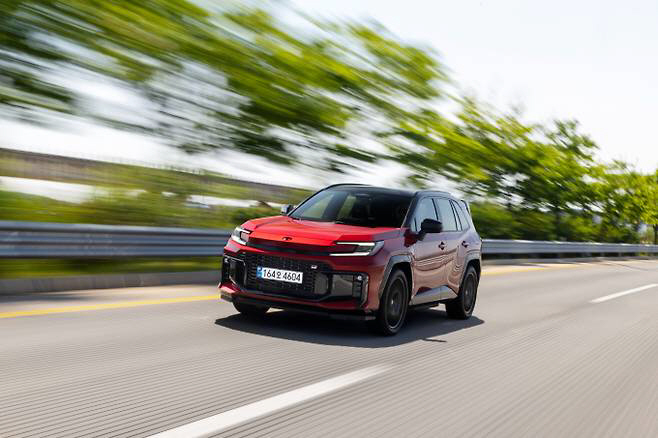
Toyota introduced the fully redesigned All-New RAV4 to the domestic market six years after its previous model. The sixth-generation RAV4 has reshaped its lineup around Hybrid Electric Vehicle (HEV) and plug-in hybrid electric vehicle (PHEV) models, while improving its appeal with the next-generation software platform, Arene. The PHEV delivers a combined system output of 329 horsepower and an all-electric driving range of up to 77 km, strengthening both performance and efficiency.
Recently, I drove the HEV Limited, PHEV XSE, and PHEV GR SPORT in succession over a roughly 127-km route around Yeongjongdo, Songdo International City, and Muuido in Incheon. Although the three models share the same platform, each had a clearly distinct character.
The HEV Limited most faithfully captured the strengths of Toyota's hybrid system. The transition between the electric motor and the engine was smooth from the start, and power delivery felt natural even during acceleration. Rather than emphasizing explosive acceleration, it focused on a supple ride and stable driving manners. Cabin quietness remained well controlled not only at low speeds but also on highways, and the setup was tuned to reduce fatigue on long drives.
The PHEV XSE is the model that most balanced the advantages of electrification. In EV mode, it offered the quietness and immediate response typical of an electric vehicle. Even after the engine kicked in, the change in driving feel was minimal. Its all-electric range of up to 77 km is enough to handle daily commuting much like an EV. On longer trips, the hybrid system naturally took over, highlighting the PHEV's ability to cover both electrified driving and long-distance travel. The 329-horsepower system output also delivered more than enough performance for overtaking and re-acceleration.

The most differentiated model was the PHEV GR SPORT. With a dedicated suspension and steering setup, body movements felt noticeably sharper than in the standard models. In consecutive corners, body roll was effectively restrained, and steering responses were more direct. Its acceleration performance is the same as the XSE, but the driving feel was clearly different from the driver's seat. It is not an especially aggressive sports SUV, but it preserves the RAV4's stability while adding more driving enjoyment.
The cabin prioritized practicality over flashy design. A 12.3-inch digital instrument cluster, a 12.9-inch center display, and an electronic gear selector improved ease of use, while the Arene platform also enhanced infotainment functions.
Prices are 57.46 million won for the HEV Limited, 61.60 million won for the PHEV XSE, and 61.80 million won for the PHEV GR SPORT. These are by no means low prices, even when compared with domestic hybrid SUVs and some imported rivals. Still, the absence of ventilated front seats in the top-priced GR SPORT is disappointing given its price. Even so, Toyota's long-cultivated fundamentals, including the refinement of its hybrid and PHEV systems, quietness, and stable driving performance, remain important factors in judging the value.
The All-New RAV4 is less a completely new kind of SUV than a model that has refined its existing strengths with greater precision. The HEV emphasizes efficiency and comfort, the PHEV XSE highlights the practicality of electrification, and the GR SPORT enhances driving enjoyment. While each trim has a different character, the common competitive edge is a more polished foundation rather than a dramatic transformation.
Moon Ji-yeon, Sportschosun
This article has been translated by GripLabs Mingo AI.